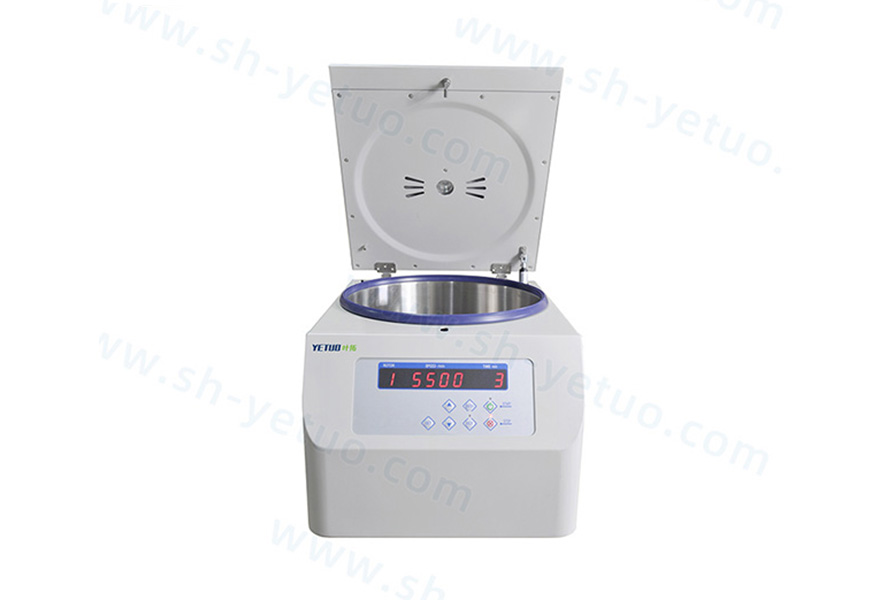



In laboratories and hospital laboratories, centrifuges are the "separation masters" - whether it's blood stratification, protein purification, or solid-liquid separation, they are indispensable. But for the same centrifuge, the difference between the "regular model" and the "low-speed multi tube automatic balancing model" is too big: one is like a "manual transmission old car", relying on experience operation; A "smart automatic transmission" that is both worry free and accurate. Below, we will explain the core differences from a practical usage perspective.
1. Balance operation: Don't worry about balancing vs. accurately weighing
Anyone who has ever used an ordinary centrifuge knows the "balancing nightmare": before setting out the sample, you have to use a balance to weigh the centrifuge tube at the symmetrical position exactly the same, which is almost impossible. If the weight deviation is slightly large, the machine will shake violently after starting, not only will the separated samples be uneven, but they will also hum and may even damage internal parts.
And the Shanghai Yetuo low-speed multi tube automatic balancing centrifuge Wan has completely solved this problem. It comes with an "intelligent balance brain" that monitors weight in real-time through sensors. Even if the difference between the two samples is within 5 grams (approximately equivalent to the weight of one drop of water), it can automatically adjust compensation without the need for manual repeated weighing. The noise during operation is particularly low, even quieter than daily speech (below 65 decibels), and it hardly affects work when placed in the laboratory.
2. Processing ability: "Fighting alone" vs "Batch efficiency"
The "capabilities" of ordinary centrifuges are very limited: most can only accommodate 1-2 specifications of centrifuge tubes, such as only 15ml tubes, and it is not possible to replace them with 50ml tubes. It is best to process 100ml samples at a time, which is suitable for occasional small experiments with a few samples.
The automatic balancing version is versatile: equipped with replaceable multi tube racks, it can accommodate centrifuge tubes of 15ml, 50ml, and 100ml, and even compatible with 96 well enzyme-linked immunosorbent assay plates (commonly used in laboratory batch testing). Like the common TD5 model, it can hold 8 100ml tubes at once, which is equivalent to 8 times the processing capacity of a regular centrifuge. If conducting batch testing, there is no need for repeated loading and unloading, and the efficiency can be directly filled.
3. Operating experience: manual estimation vs Jing quasi intelligence
The operation of a regular centrifuge relies entirely on "manual manipulation": the speed can be adjusted with a knob, with an error of ± 50 revolutions per minute, and the time can only be set in minutes, for example, it cannot be set for 30 seconds. If fine experiments are conducted, such as biological sample separation, the results may be inaccurate if there is a slight difference in speed or time.
The automatic balancing model is a "foolproof" model: operated by a touch panel, the speed error can be controlled within ± 30 revolutions per minute, and the time can be adjusted to 1 second (freely adjustable from 1 second to 99 minutes). More practically, it can directly switch between rotational speed (rpm) and centrifugal force (RCF) without manual conversion. Experimental data can be directly compared to standard requirements, and beginners can quickly get started.
4. Applicable scenarios: Basic requirements vs fine scenarios
Ordinary centrifuges like the "Wan Neng Basic Model" are suitable for scenarios that do not require high precision, such as simple solid-liquid separation in chemical laboratories and precipitation extraction in food testing. They are inexpensive, easy to operate, and meet basic needs.
The automatic balancing model is a "precise and customized" model, specifically designed for high demand scenarios such as blood product separation in hospitals, genetic engineering experiments in scientific research, and batch testing in biological companies. These scenarios require both precise separation and efficient batch processing, and its stability and intelligence perfectly match the requirements.
Simply put, ordinary centrifuges excel in being "cheap and practical", suitable for basic separation; The low-speed multi tube frame automatic balancing centrifuge wins in "worry free and accurate efficiency", making it the preferred choice for fine experiments and batch operations. No matter which one to choose, it depends on your experimental needs - there is no need for complex operations, occasional use, the regular version is sufficient; To achieve batch processing and precision, automatic balancing is the cost-effective choice.